Chat that remembers
Streaming conversation across Claude, GPT, and Gemini. A router sends easy turns to a fast model and hard ones to a stronger model, so you are not paying frontier prices for small talk.
Most people pay for four or five AI tools that never talk to each other. ClavexisAI puts them in one place — conversation, a full code workspace, cited research, autonomous agents, and creative studios — on top of memory every one of them can read.
355 features across 31 categories, built. No spam — one email when access opens.
The product
Real screens from the build that is in testing right now — not mockups. Here are nine of them.
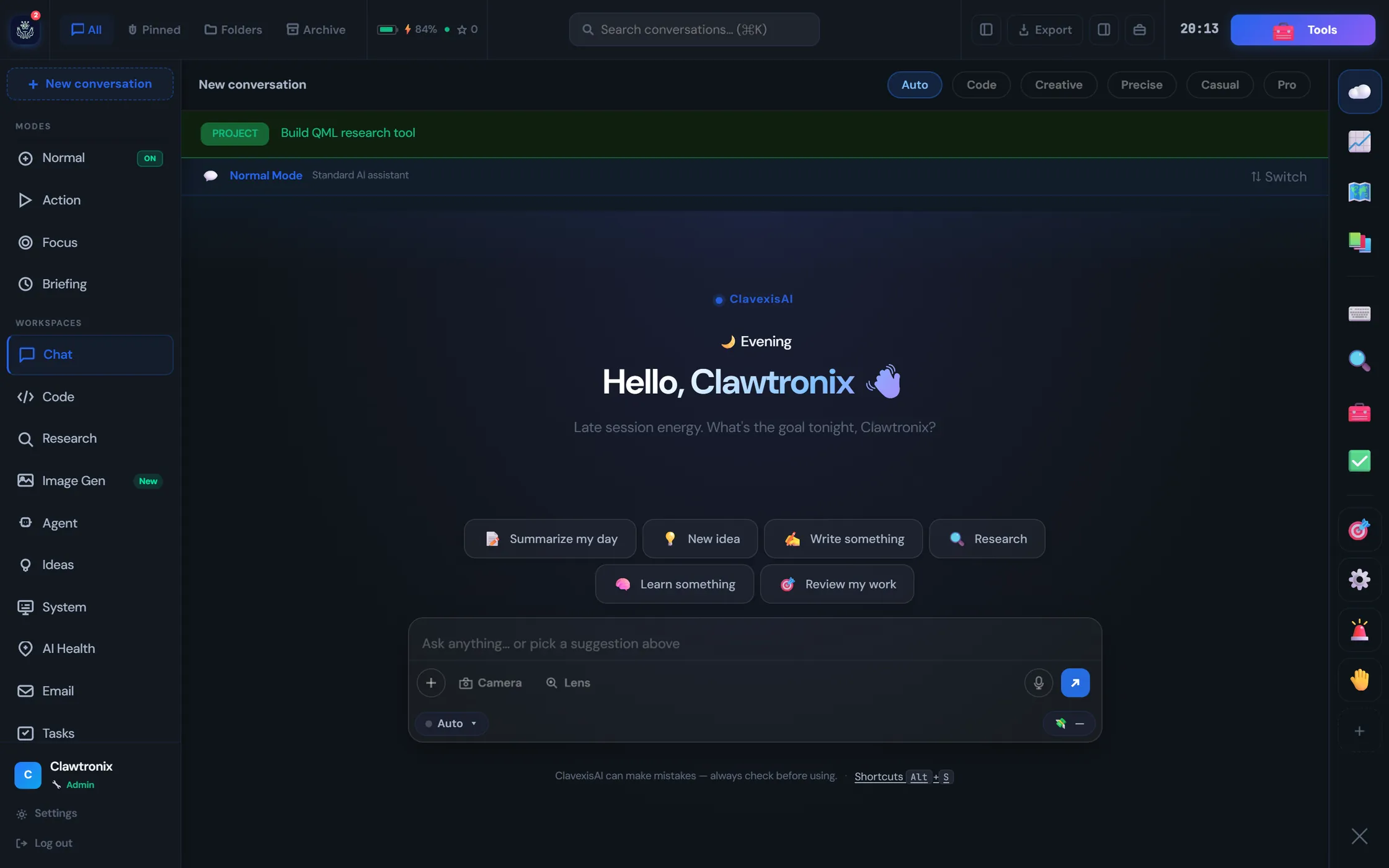
Chat. Modes for everyday talk, action taking, focus and daily briefing. Projects, folders, pinning and export are built in, and the composer takes camera and screen input as well as text.
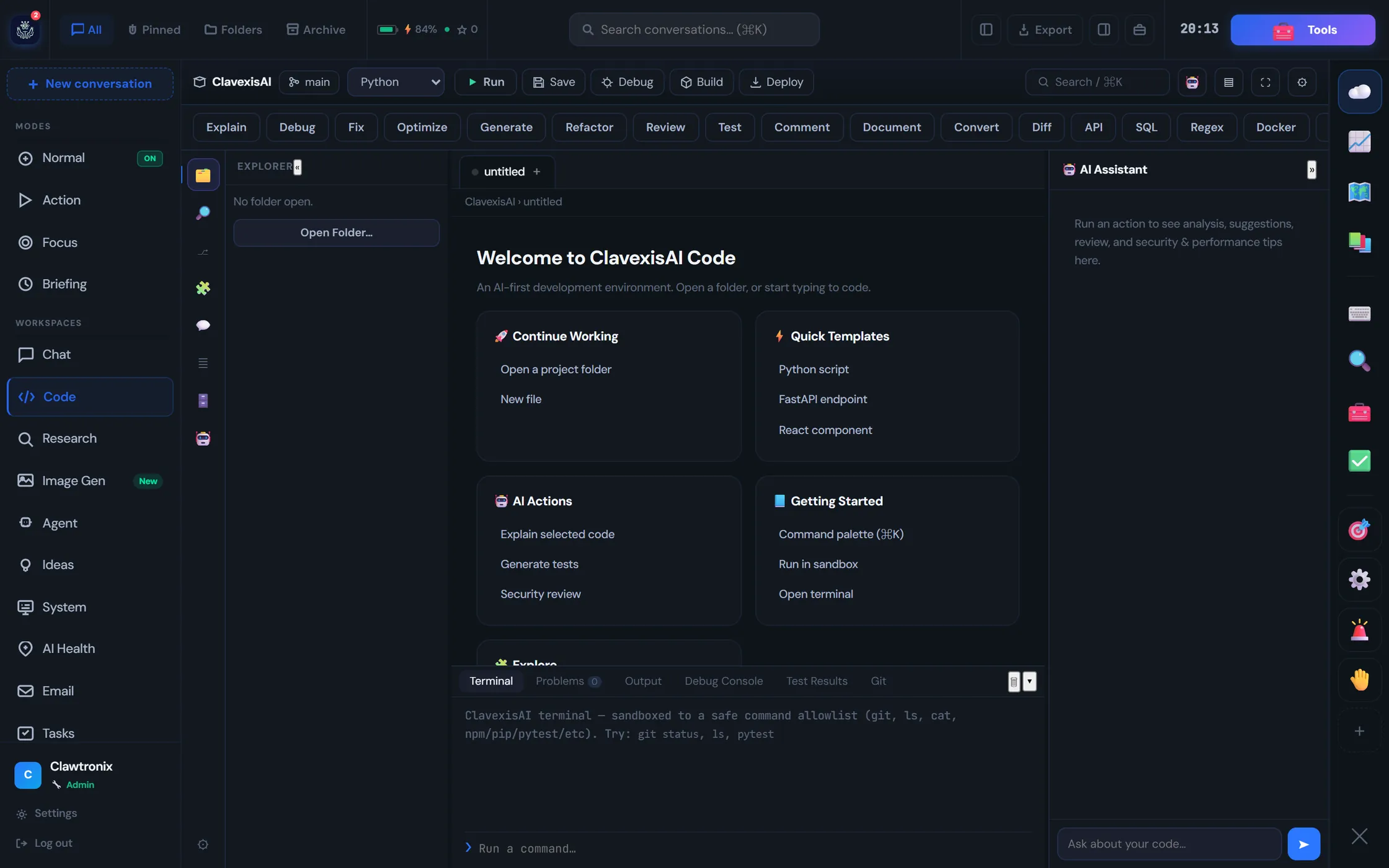
Code. A full development environment: explorer, editor, git, and a terminal sandboxed to a safe command allowlist. One-click Explain, Refactor, Review, Test, Security Scan, Docker and CI/CD actions, with an AI assistant beside the file.
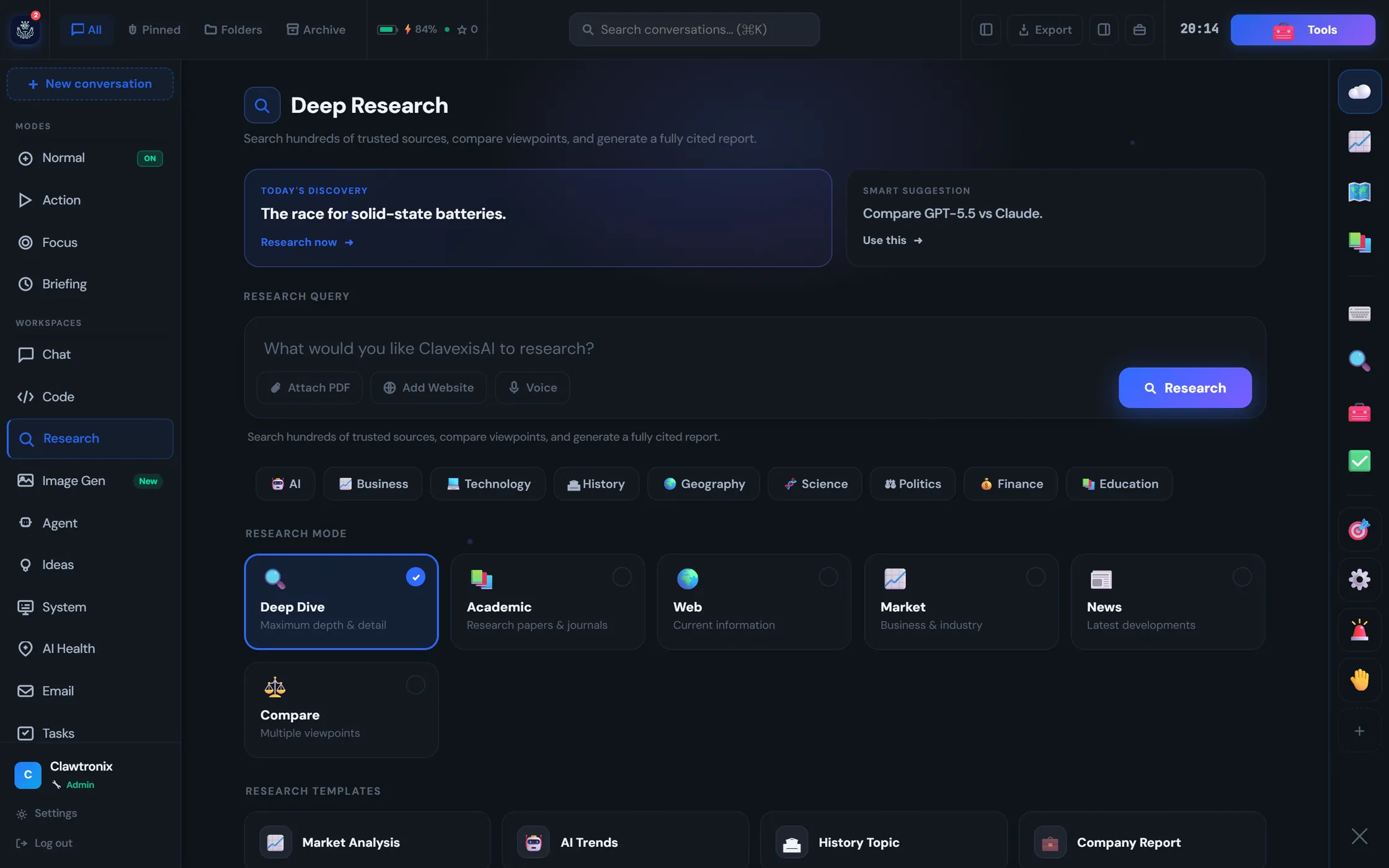
Research. Pick a depth — deep dive, academic, web, market, news, or a side-by-side compare — attach a PDF or a site, and get back a fully cited report rather than a paragraph of guesses.
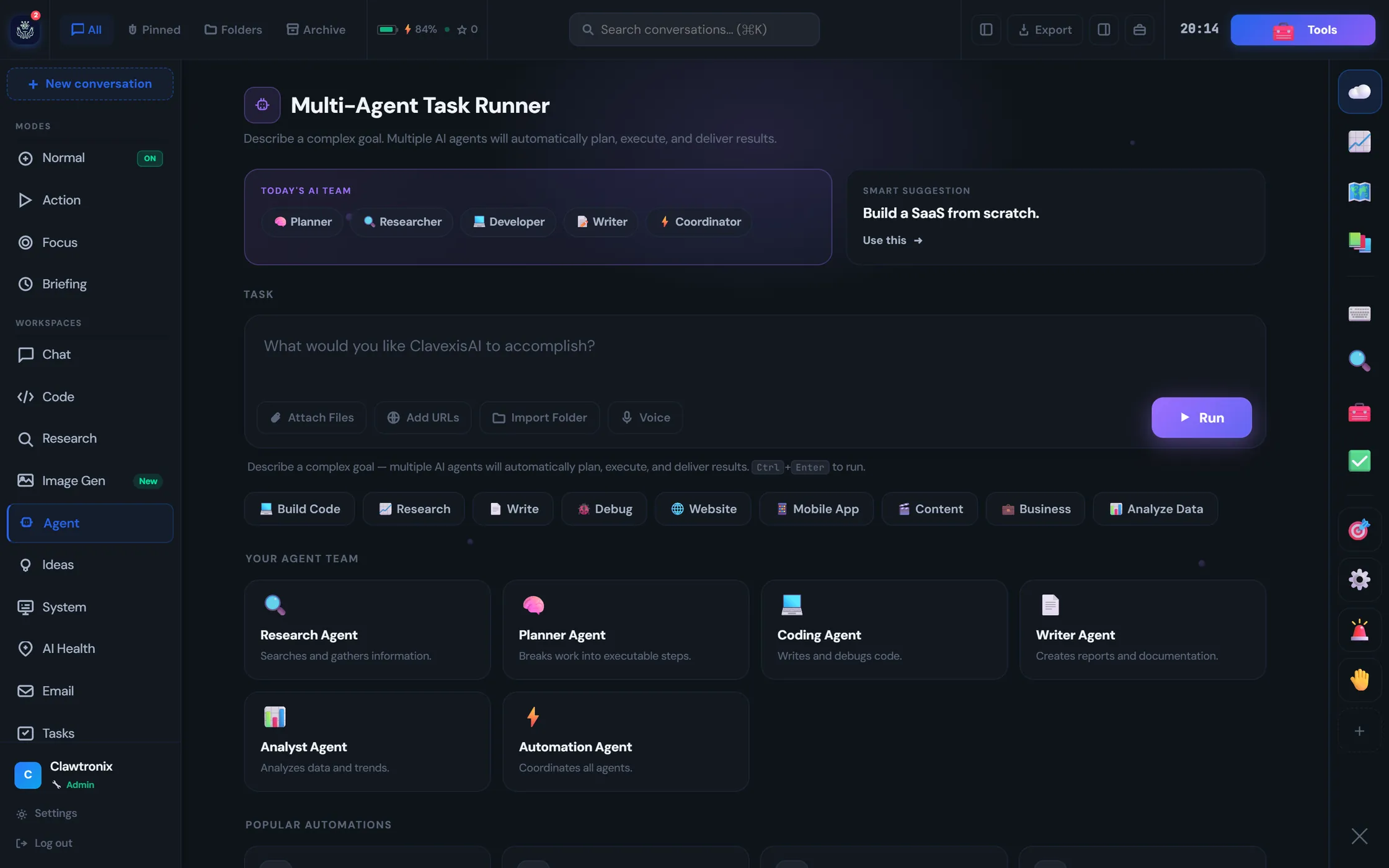
Agents. Describe a goal and a team picks it up — planner, researcher, developer, writer, analyst, coordinator. They split the work, run real tools, and deliver files you can download.
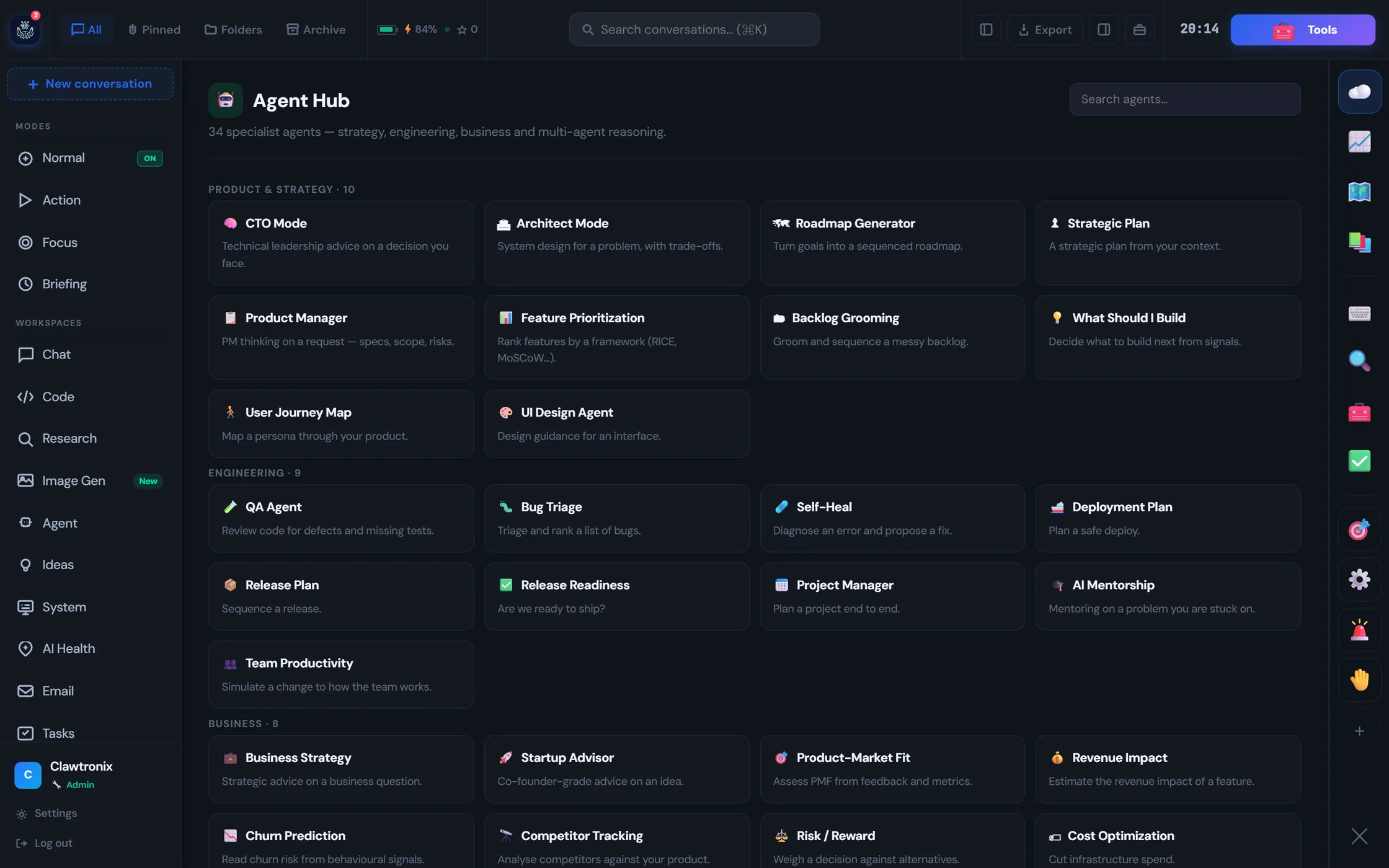
Agent hub. Thirty-four named specialists, grouped by discipline — CTO mode, architect mode, QA, bug triage, release readiness, churn prediction, product-market fit. Pick the one that matches the problem instead of re-explaining context every time.
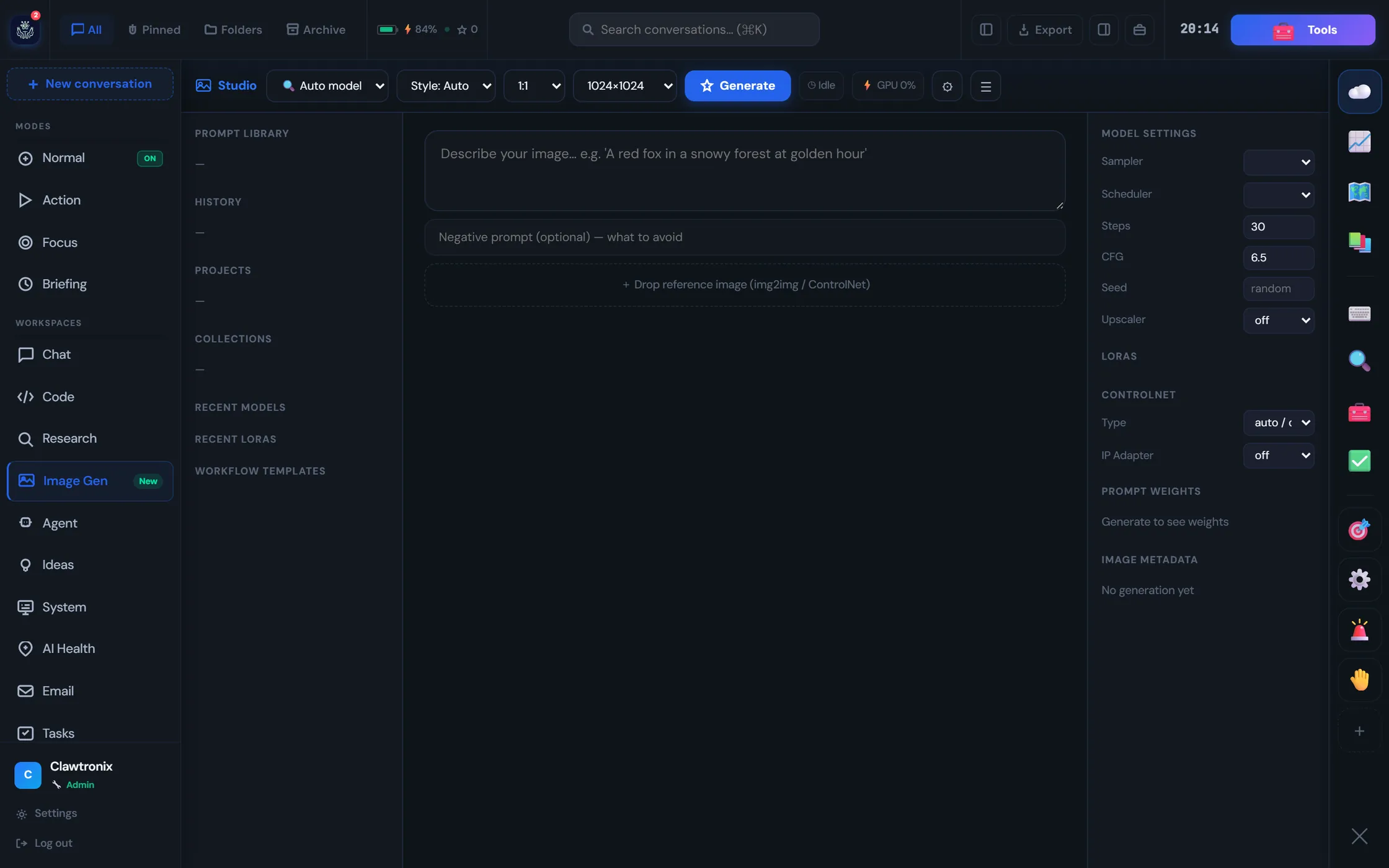
Image studio. Prompt and negative prompt, reference images, and the controls that actually matter — sampler, steps, CFG, seed, upscaler, LoRAs and ControlNet — with a prompt library and history alongside.
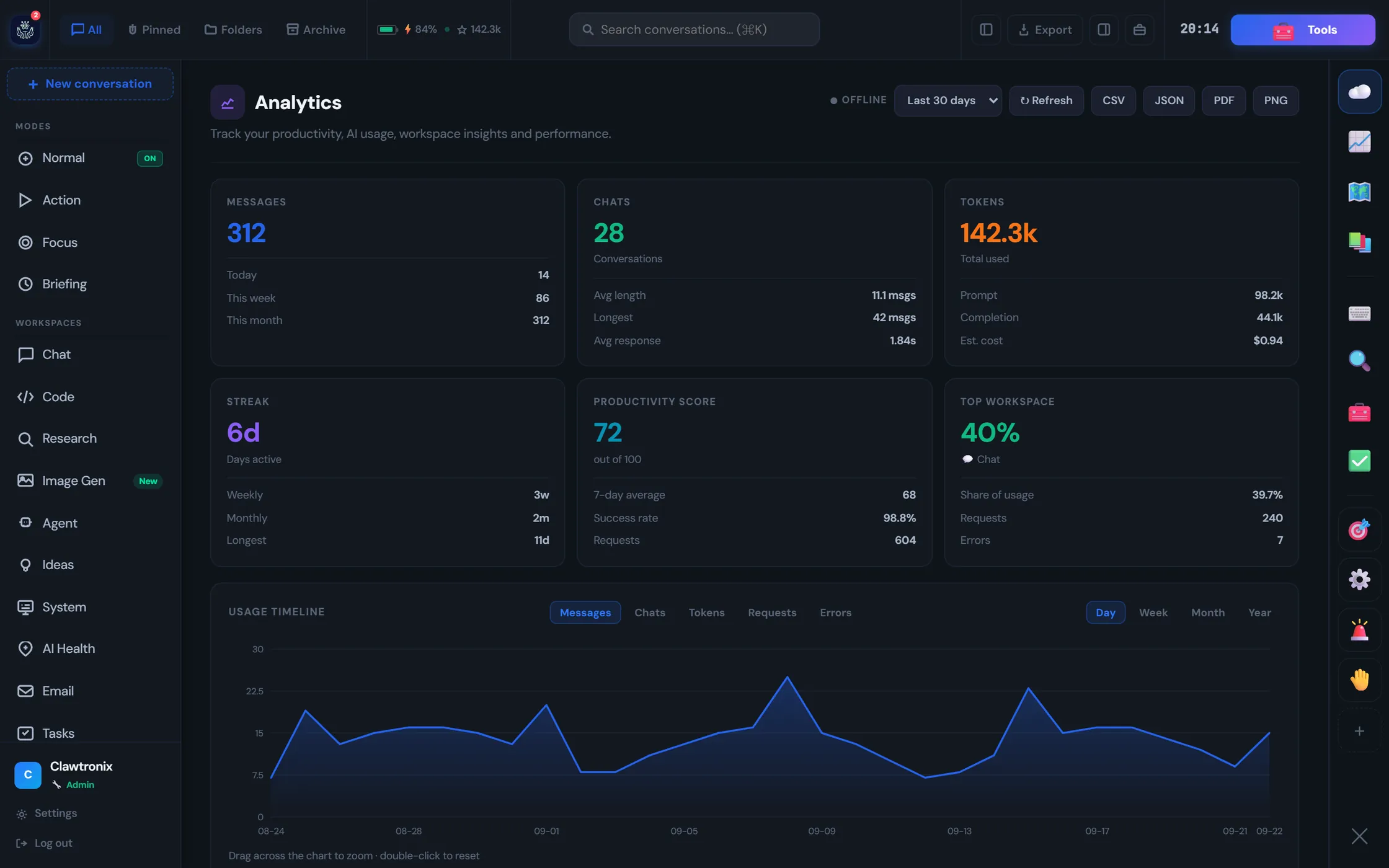
Analytics. Where your time and tokens actually went: messages, conversations, token spend, storage, a productivity score, and a usage timeline you can slice by day, week, month or year. Exportable as CSV, JSON or PDF.
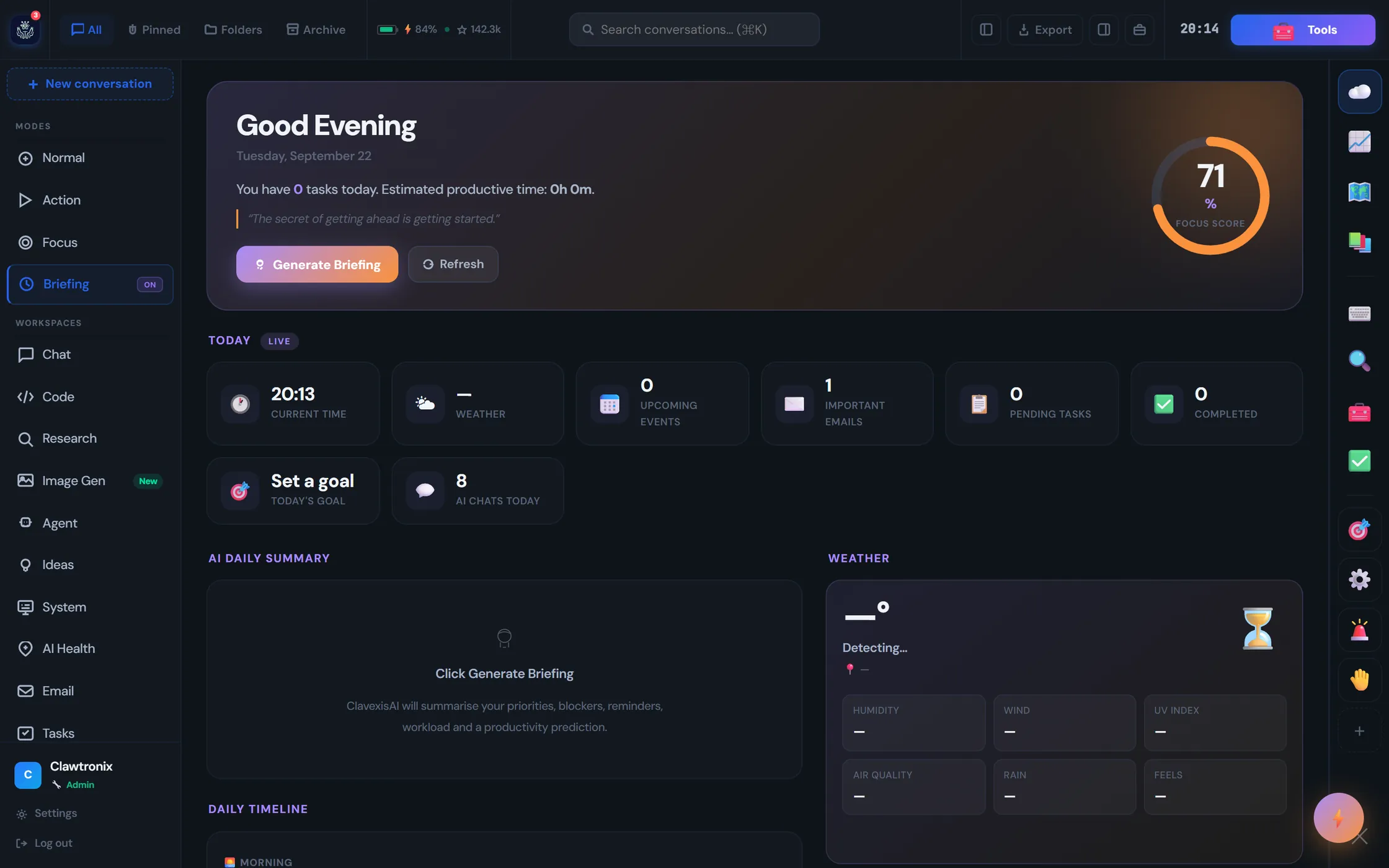
Briefing. A standup for your own day — productivity score, what is scheduled, what is still pending, the goal you set, and a written summary of what actually matters, generated when you ask for it.
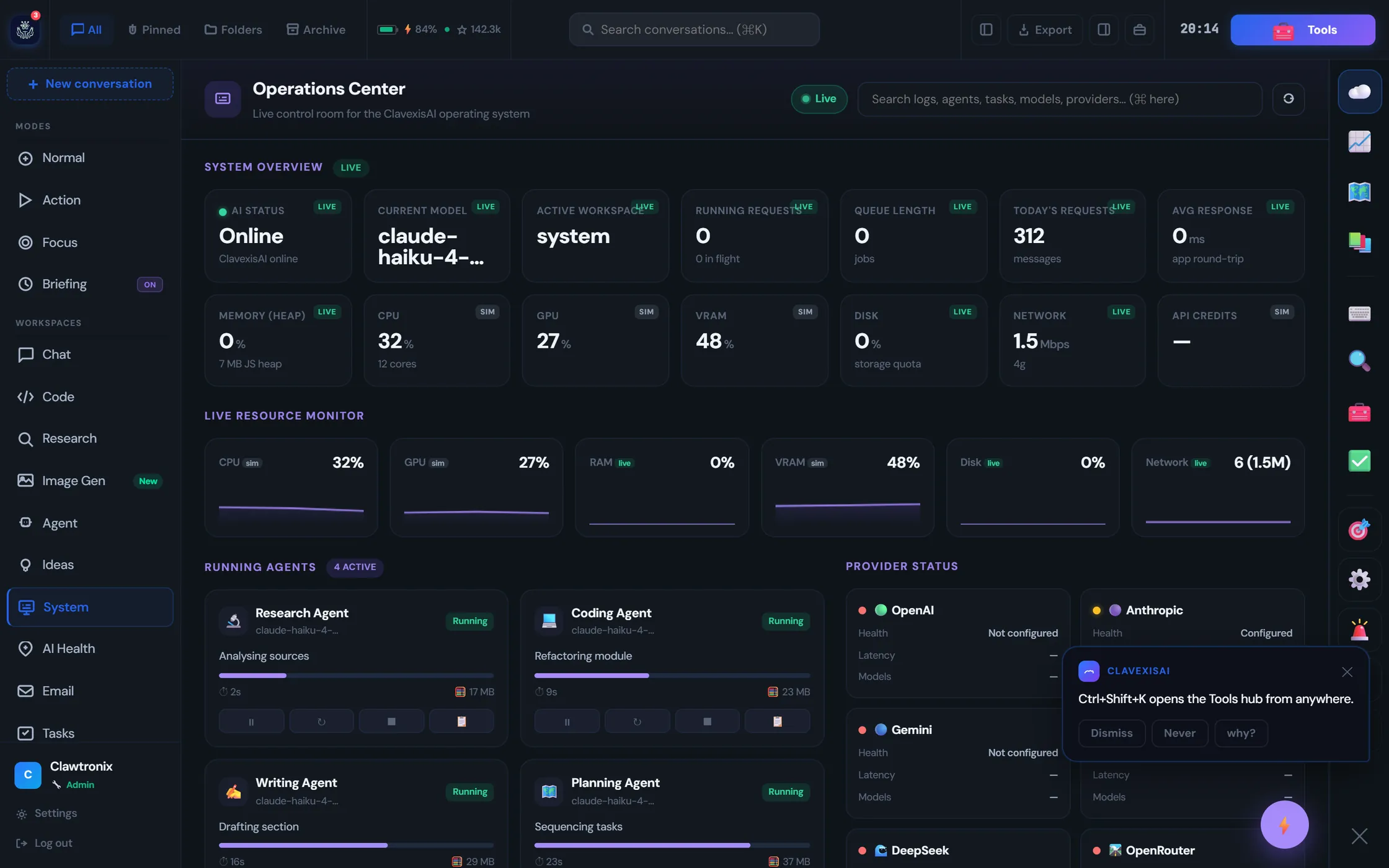
Operations. The control room: which model is serving, request volume, memory and CPU, every running agent with the step it is on, and live status for each model provider. Useful when you self-host and own the uptime.
Capabilities
Every workspace shares the same memory, the same files, and the same model router. Research something on Monday and the code workspace still knows about it on Friday.
Streaming conversation across Claude, GPT, and Gemini. A router sends easy turns to a fast model and hard ones to a stronger model, so you are not paying frontier prices for small talk.
Whole-repo indexing and semantic search, cross-file refactoring with diffs, generated tests, and a sandboxed runner held to an explicit command allowlist. Ten specialist agents cover frontend through security review.
Multi-source search that actually fetches the pages, then returns inline citations, contradictions between sources, and a reliability score for each one — assembled into a report you can keep.
Hand over a goal. The agent plans it, runs real tools — search, browse, code, files, email — and hands back downloadable artifacts, with every step visible while it works.
Generation and editing guided by ten specialist image agents, plus vision that reads screenshots, diagrams, charts, and webcam frames. Video work covers transcripts, scenes, and clip extraction.
Speech to text runs locally through Whisper, so dictation works offline. Neural voices read replies back, a wake word starts a session, and spoken commands drive the app itself.
Wire steps into a workflow with triggers, schedules, branching, and approval gates. Actions reach email, files, HTTP APIs, and code execution, so routine work runs without you.
One FastAPI process, SQLite locally or PostgreSQL in production, Redis for cache, ChromaDB for vector memory. A single Docker Compose file brings the whole stack up on your own server.
How it works
Plain language, typed or spoken. No mode to pick first, no prompt formula to learn, no separate app to open.
Intent detection decides whether this is a quick answer, a research job, a code change, or an agent run — then picks the model tier that fits the work.
Reports with citations, code with diffs, generated images, documents you can download — not just a wall of chat text to copy out by hand.
Everything in the box
This is the complete build list, exactly as it is tracked internally. Open a category to read every item in it, or search across all of them.
Counts come straight from the project's own feature checklist. One item is still a demo stub and the items under Roadmap are not shipping yet — those are called out rather than counted as done.
Pricing
Daily message limits keep the cost predictable. Need more on a busy week? Credit packs top you up without changing plan.
A proper look before you pay.
Everyday work, all the core workspaces.
Starter, on a stronger model, with credits.
For people who ship: code, agents, builders.
Everything, on the strongest model.
Credit packs for heavy weeks: 500 for $10 · 1,500 for $25 · 4,000 for $50.
Prices shown are at launch, billed through Stripe. Cancel whenever you like.
Roadmap
These are in development, not shipping. Everything above this section is built and in testing.
Gmail and Outlook over OAuth, replacing the current demo inbox.
Shared workspaces, projects, and memory for more than one seat.
Native shells around the workspace, plus the desktop overlay.
Local currency and pricing that reflects where you actually live.
Early access goes out in batches while the last pieces are finished. Leave an email and you will hear from us once — when it is your turn.
No spam, no newsletter, no sharing your address.